
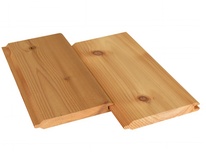
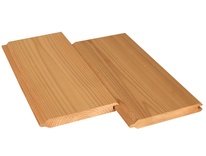
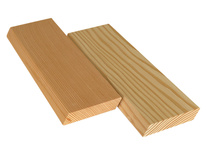
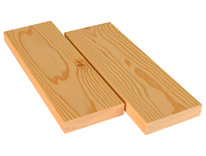
Western red cedar, sawn timber 21 x 150 mm, STK grade

Format: 21x150 mm,
sawn timber,
STK grade, knotty, kiln-dried


Detailed Description

Western red cedar, sawn timber 21x150 mm, STK grade
Wood species: Western red cedar
Botanical name: Thuja plicata
Origin of timber: Canada
Dimensions: 21x150x2100–5700 mm
As this sawn timber is intended for further processing, dimensional variations
may occur
Density: approx. 400 kg/m³
Durability class EN350: 2
Finish: KD
kiln-dried
Application: sawn timber for further processing
Timber grading: STK, knotty grade
Packaging: loose
Specification points
Information about Western Red Cedar
Western red cedar is a legend amongst timber species and, thanks to its unique properties, is the best choice for your timber-framed building and cladding. No warping, high stability, long life, a wonderful scent, resistance to the weather and wood-destroying insects – these are just a few of its unique properties, which have been known for generations. The Elite grade of cedar is characterised by an unlimited number of knots.
Specific gravity
One of the lightest commercially used softwoods, kiln-dried Western Red Cedar has a density of approximately 400 kg/m³. The low density of Western Red Cedar enhances its thermal insulation properties and is the reason why this timber is easy to transport and handle.
Dimensional stability
Like any other timber, Western Red Cedar is hygroscopic and absorbs or releases moisture to maintain equilibrium with its surroundings. Nevertheless, it has a very low shrinkage coefficient and, compared with other softwood sawn timber, is highly resistant to warping, twisting and cracking.
Thermal conductivity
Wood is an excellent thermal insulator. This is a very important property, as materials with good thermal insulation properties help to keep the interior of a building cool in summer and reduce heating costs in winter. The thermal conductivity of wood is directly dependent on its density (specific gravity). Wood with a low specific gravity has the best thermal insulation properties, as such wood contains a large number of air pockets. When the wood is dry, these air pockets are filled with air, which is one of the best known thermal insulators. Thanks to its low specific gravity and high proportion of air cavities, western red cedar is one of the best thermal insulators compared with other commonly available types of softwood, and is incomparably better than bricks, concrete and steel. It has a thermal conductivity coefficient (k-value) at 12 per cent moisture content of 0.74 BTU inch/ft²h °F (0.106 Wm⁻¹K⁻¹). The R-value (1/k) of red western red cedar is 1.35" (34 mm) thick.
Sound insulation properties
An important property of timber in terms of sound insulation is its ability to absorb vibrations. Wood has a cellular structure consisting of tiny, interconnected pores which, through friction and viscoelastic resistance, convert noise into thermal energy. Due to the high level of internal friction generated within its cellular, porous structure, timber has a much greater capacity to dampen sound than most building materials. When used correctly, floor, ceiling and wall structures can provide cost-effective sound insulation. Western red cedar is particularly suitable for this purpose and can be used to reduce noise or soundproof spaces.
Durability
In the past, the indigenous peoples of the Pacific coast valued western red cedar for its durability and consistent quality, and used both the timber and the bark for most of their building structures. Evidence of its durability – and therefore long service life – can be seen in the many products made from western red cedar that are still in very good condition. If western red cedar is properly surface-treated and maintained, its service life can be measured in decades. If it is to be exposed to conditions that may cause it to rot – such as when the timber is in contact with the ground – western red cedar must be treated with a suitable wood preservative.
Avoid contact with corrosive metals
Contact between the timber and corrosive metals can cause black stains on the timber that are difficult to remove. Therefore, use only stainless steel fixings for installation and prevent contact with corrosive metals. Hot-dip galvanised, aluminium and stainless steel fixings are all corrosion-resistant and may be used for installing western red cedar. Other types of fasteners are not recommended. They may corrode, disintegrate and react adversely with the natural preservative oils present in the cedar, leading to the formation of stains. Copper fixings also react with cedar and should not be used. Stainless steel fixings are the best choice, particularly if the cladding is to be finished with a clear glaze or left unpainted.
Elite Grade
Elite-grade cedar cladding is supplied with an unlimited number of knots. Red Western cedar is used to manufacture a whole range of specialised products, such as façade cladding, interior panelling, floor structures and flooring for external structures exposed to the elements.
Colour Tolerances
Western red cedar is characterised by a wide variety of colours. Western red cedar occurs in many colour shades, and marked colour variations are characteristic of this timber and are permitted without restriction even in the highest ‘Clear’ grade. Its colour variation is precisely one of the hallmarks of this unique timber. Every piece of timber is a unique original derived from naturally grown trunks, and it is never possible to achieve uniformity in colour or grain. When western red cedar is exposed to UV radiation, it will turn grey over time, just as is the case with all types of timber.
Demand
We will show you our products before purchase in our warehouse. Wood is a natural material, each piece is a unique original. The supplied wood will be different from the displayed photos and samples.
Call us on +420 220 879 443
Payment options:
- Cash or a card at the store
- Cash on delivery (you pay when picking up the goods to the courier in the Czech area only )
- By bank transfer (we will send the goods immediately after the amount has been credited to our account)