
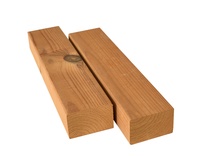
Thermowood Trapez decking boards 19x90 mm

Thermowood pine,
thermally modified to class D for outdoor use,
Trapez decking profile,
dimensions: 19x90 mm


Detailed Description
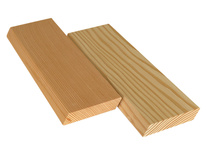
Thermowood pine, Trapez decking boards 19x90 mm
Wood species: pine
Botanical name: Pinus sylvestris
Origin: Finland
Dimensions: 19x90x3000–5100 mm (the width and price of the profile include the tongue)
Density: 400 kg/m³
Durability class EN350: 2
Heat treatment: original Thermowood, type-D
thermal modification Grade: AB, with knots
Packaging: sold individually
Profile: Trapez decking with tongue and groove

Specification points
ThermoWood – an innovative thermal treatment process for timber with enhanced properties
It has been known for centuries that charring the surface of wood over an open fire increases its durability when used outdoors. The thermal treatment of wood is, in itself, a very ancient technology, known and used as far back as ancient times by Native American tribes, who observed that fire-charred wood exhibited a much longer lifespan, resistance to rot and weathering. Wood treated in this way was used, for example, in the construction of Native American tepees. Archaeological finds have confirmed that the Vikings used this method of treating wood for their buildings and fortifications.
The heat treatment of wood was scientifically investigated as early as the 1930s in Germany and subsequently in the 1940s in the United States. In the 1950s, this research was continued in Germany, and in the 1990s, research was carried out in Finland, France and the Netherlands.
The most intensive and comprehensive research was carried out by VTT in Finland.
Significant practical research is also being carried out by YTI – the Institute of Environmental Technology. The current ThermoWood treatment is produced using a method developed by VTT. The timber, when exposed to high temperatures, is protected by steam. In addition to providing protection, the steam also influences the chemical changes taking place within the timber. The result of this treatment is the creation of the environmentally friendly ThermoWood product. As a result of this treatment, the wood darkens, becomes more stable than normal wood under conditions of fluctuating humidity, and its thermal insulation properties are improved. If carried out at a sufficiently high temperature, the treatment also makes the timber resistant to rot. Our company imports only certified ThermoWood from Finland.
Beware of imitations! What is the difference between ThermoWood and, for example, Thermopine?
Only timber produced using the original Finnish method developed by VTT and approved by the ITWA may bear the ThermoWood designation. This is a registered trademark of the International ThermoWood Association. However, non-genuine products, often of unknown origin, can be found on the market; these are not produced using the original method and must not be called ThermoWood. They are therefore most commonly labelled as ‘Thermo-pine’, ‘thermo-wood’ or other similar terms. If these products are manufactured at a lower temperature, for example 180°C, they are not intended for outdoor use and are characterised by lower durability than timber modified at 212°C. Thermal modification at 212°C or higher is intended for external use.
ThermoWood with Thermo-D treatment, at 212°C, offering enhanced durability for outdoor use
Original ThermoWood has two standard treatment grades, Thermo-S and Thermo-D, depending on the treatment temperature. Once the processing temperature exceeds 200 °C, the properties of the timber change rapidly. The letter ‘S’ in ‘Thermo-S’ stands for ‘stability’. Production takes place at a temperature of 185 °C and, alongside appearance, stability is a key property for the end use. The Thermo-S grade is generally intended for interior use. According to the EN 113 classification, the thermal modification meets the requirements of Class 3. The letter ‘D’ in ‘Thermo-D’ stands for ‘durability’. Alongside appearance, biological durability is a key property. Thermo-D, as classified under EN 113, meets the requirements of Class 2. ThermoWood type D is treated at a temperature of 212 °C; due to its increased durability, it is intended for outdoor use and exposure to the elements. We supply ThermoWood exclusively in thermal modification class D.
Durability
Thermal treatment gives the timber new beneficial properties, such as long-term durability and excellent resistance to rot, decay and weathering.
Colour
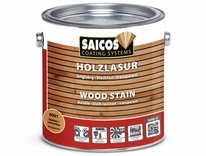
The surface of Thermowood turns grey easily, and exposure to the elements causes the wood’s surface to weather. Thermowood readily accepts the same types of surface finishes as other woods. Thermowood readily accepts and absorbs oil-based coatings. When using water-based coatings, absorption into the wood is slower; it is therefore recommended to use products with a longer drying time to ensure the wood is sufficiently saturated.
If you wish to restore the wood’s original colour, use the professional Saicos grey remover  in accordance with the technical data sheet. Then treat the wood with a suitable protective coating.
Properties
When working with ThermoWood, bear in mind two important factors:
Use sharp tools to achieve the best possible result. Thermowood is slightly more brittle and drier than ordinary timber, so cutting should be carried out at a slower speed than when cutting normal timber. The lack of resin makes cutting and sanding easier. The dust produced from sawdust during processing is very dry and fine; it is therefore recommended that you wear a respirator. Work areas should be fitted with their own ventilation system to remove dust.
The Thermowood heat treatment process may increase the wood’s susceptibility to cracking. There may be slight variations in the width of the timber due to differences in expansion as the timber adjusts to moisture levels, between the radial and tangential growth directions. In timber exposed to outdoor weather conditions, cracks, sagging (known as ‘troughing’), warping and twisting, as well as cracks and splits – particularly at the ends of the planks – due to shrinkage, which varies depending on relative humidity or changes in climatic conditions, and small holes caused by wood-boring insects. The above-mentioned characteristic properties of wood cannot be regarded as defects.
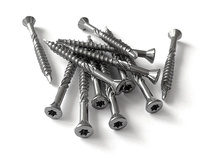
Always pre-drill holes for screws to prevent the material from splitting. The use of self-tapping screws without pre-drilling is not recommended. It is recommended to use low-profile screws. It is very important to use stainless steel screws and fasteners with countersunk heads for external use or in damp environments.
Knots and other natural features of wood
Knots and eyes, whether sound or partially healed, cracks around knots, medullary channels, resin ducts, marbling and other natural characteristics are an integral part of the timber.
ThermoWood Technical Data Sheet
Technical information on ThermoWood can be found here
Storage
When storing timber before and during installation, ensure that it is not exposed to direct sunlight, rain, snow or other external influences. It should be well covered or, ideally, stored in covered, unheated areas, with relative humidity levels matching those of
the outside air. At the same time, ensure that the timber is adequately spaced with spacers to allow for air ventilation and prevent the formation of mould. Failure to follow these recommendations may result in warping, deformation or other changes to the timber during storage.
Download
Demand
We will show you our products before purchase in our warehouse. Wood is a natural material, each piece is a unique original. The supplied wood will be different from the displayed photos and samples.
Call us on +420 220 879 443
Payment options:
- Cash or a card at the store
- Cash on delivery (you pay when picking up the goods to the courier in the Czech area only )
- By bank transfer (we will send the goods immediately after the amount has been credited to our account)